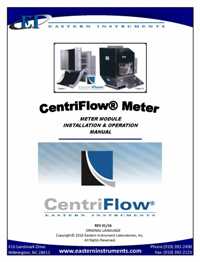
The CentriFlow Meter from Eastern Instruments is a Solid Particle Mass Flow Meter that is durable, accurate, maintenance-free, compact, and cost-effective. It is unique and positioned to replace weigh belts, impact meters, loss in weight meters, and static weigh scales, anywhere that accuracy, low maintenance, and zero drift are paramount. Utilizing our patented CentriFlow Technology, the CentriFlow Meter offers accurate, cost-effective and simple solutions to your process measurement needs.
The CentriFlow CFL Meter is a low flow version of the CentriFlow meter that allows for extremely accurate flow measurement of any flowable solids down to 100 lb/hr.
TECHNICAL
FEATURES AND BENEFITS
APPLICATIONS
DOWNLOADS
INTRODUCTION TO TECHNOLOGY
ELECTRONICS
CFL: Low Flow Meter
TECHNICAL INFORMATION
Below, you will find the installation and operation manuals for the CentriFlow CFL family of solids flow meters. The manuals have been divided into the Mechanical Manual for the meter module and the Electronics Manual for the touchscreen interface and setup. There is also a section for troubleshooting and maintenance procedures as well. Feel free to Contact Us with any questions.
The CentriFlow Meter offers a typical accuracy of within +/-0.25 - 0.50% for most flowable solids.
The CentriFlow Meter is a gravimetric solids flow meter that utilizes a centripetal force based flow measurement technology to maintain an extremely accurate flow measurement.
The CentriFlow Meter is not affected by changes in product elasticity, density or shape. Even changes in flow rate have little impact on the flow measurement accuracy.
The CentriFlow Meter measures product as it slides across our measurement pan, however, due to the patented design of the flow meter, the CentriFlow actually cancels the frictional force components so that friction of the product being measured does not impact the accuracy of the measurement.
Constructed entirely from welded Stainless Steel, including the flow paths, the CentriFlow CFL Meter is a very low maintenance device. With few moving parts, the CentriFlow is extremely durable and will last long in to the future.
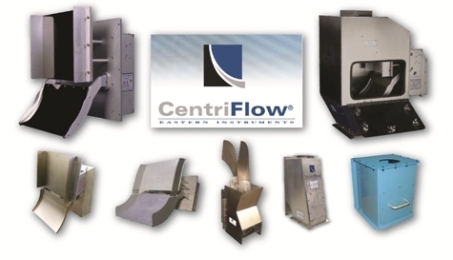
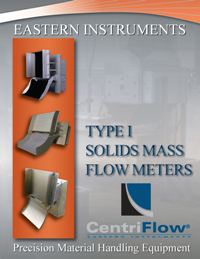
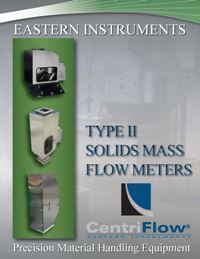
Designed to fit in nearly any existing process, the CentriFlow is available in two adaptable configurations. The Type I Meter is an open concept meter that can be installed after horizontal feed devices like belt conveyors or vibratory conveyors. The Type II Meter is an enclosed meter that is often installed after devices that convey product in a vertical direction, such as rotary valves or screw conveyors.
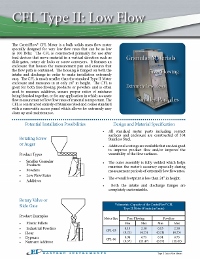
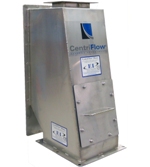
The CentriFlow CFL Type II Meter (with enclosure) has a very small vertical footprint that measures under 24 inches in vertical height. The CFL can be mounted nearly anywhere.
The CentriFlow family of meters are highly customizable and can be tailored to nearly any product and for nearly any application. Below are just a few of the more widely utilized options. For more information on the full range of customization available for the CentriFlow family of meters, contact us today.
MATERIAL OF CONSTRUCTION
METER CASING AND ENCLOSURE:The meter casing is typically available in Stainless Steel (304 and 316).
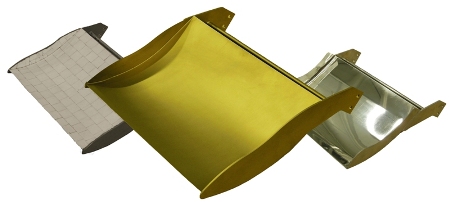
FLOW SURFACES: The flow surfaces of the CentriFlow, including the Pan, the Tangential and the Diverter will be a welded, one-piece assembly. This type of pan configuration can accommodate a variety of coatings for wear resistance, flow enhancement and many other requirements.
DUST CONTROL
AIR PURGE SYSTEM: The Air Purge System, typically used for dust and moisture control, fills the back casing of the meter with instrument quality air, thereby creating a positive pressure to keep condensation, dust and other matter from interfering with the measurement.
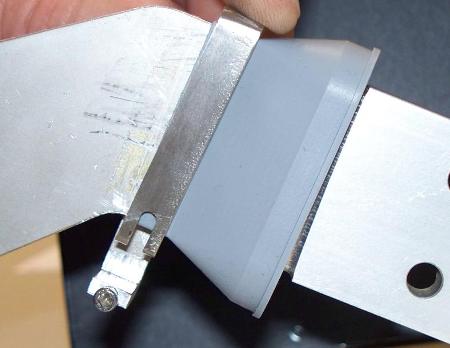
BOOT CLAMPS: Boot clamps seal the Pan Arm Boots ensuring that dust and moisture from the process are unable to enter the rear of the meter, thus causing erroneous readings or possible damage to the loadcell of the meter.
FLOW ENHANCEMENT
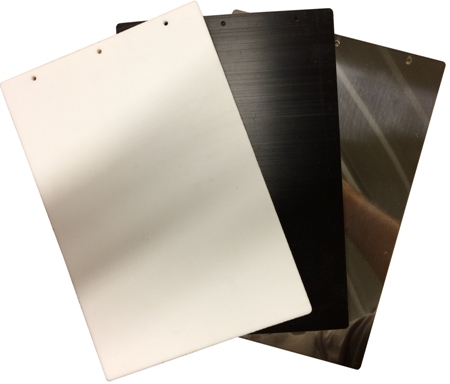
LINERS AND COATINGS: A variety of coatings as well as flow surface materials can be utilized in order to improve the flow of products across the Measurement Pan and other flow surfaces. In addition, a Curved Corner Pan is available for powdery products that could collect in the corners of a standard Pan.
PULSED AIR SYSTEM: The Pulsed Air System was designed to deliver a pulsed blast of dry, instrument air to the area both above and below the Measurement Pan in a manner that will clear product and debris from the Pan's surfaces without adversely affecting flow measurement readings. Use of the Pulsed Air System is intended to both assist product flow as well as to eliminate product built up on the Pan, which, if left unchecked, could result in less accurate flow measurement.
INTEGRATED AIR ENTRAINMENT: The Integrated Air Entrainment System was designed to deliver a continuous stream of air to the CentriFlow Meter's Measurement Pan. Its continuous flow of dry air reduces build up and assists in the flow of product on the measurement surfaces without affecting measurement readings as well.
VIBRAWEIGH: The VibraWeigh option, typically used in powder applications, keeps small particle size materials (down to 10-50 microns) from building up on the Pan surfaces. The VibraWeigh works by gently vibrating the Measurement Pan from side to side in a manner that keeps product flowing across the Measurement Pan without building up, while at the same time, not affecting the measurement accuracy of the meter.
EXPLOSION CONTROL
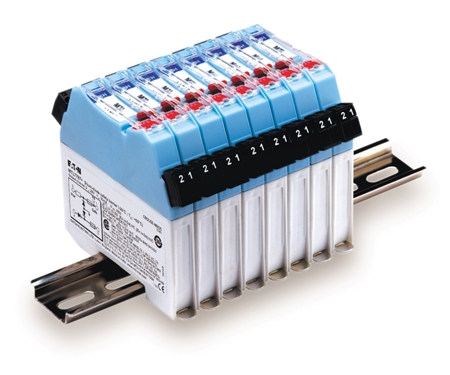
INTRINSIC SAFETY BARRIERS: Intrinsic Safety Barriers are used when the CentriFlow Meter will be installed within a hazardous area and the CentriFlow electronics will be located within a non-hazardous area in order to isolate the CentriFlow Meter from its electronics.
EXPLOSION PROOF SYSTEM (CLASS II DIV 2): This explosion proof system is used for installing the CentriFlow Meter and its electronics within a Class II Div 2 rated area and includes a pressurization or purging system that prevents the entrance of combustible dust into the meter or its electronics.
EXPLOSION PROOF SYSTEM (CLASS I DIV 2): This explosion system is used for installing the CentriFlow Meter and electronics within a Class I Div 2 rated area. This option prevents the entrance of flammable gas or vapor from accumulating within the meter or its electronics by performing a series of four air exchanges and then, applying a positive pressure to the system.
Sorry! Our website is currently undergoing some improvements and not all of the content has been added. It is coming soon though. Try us back in a little bit!
DOCUMENTATION
Below, you will find a variety of product literature including product catalogs, single page cut sheets and various application guides that can assist in selecting the correct flow meter for your project. If you have any questions, please feel free to contact us and we will be happy to help.
SOLIDS FLOW PRODUCT CATALOGS
CUT SHEETS
MISCELLANEOUS DOCUMENTATION
CONFIGURATIONS
Below, you will find a description of the standard configurations for the CentriFlow CFL style meter. While the configurations shown here are a standard offering, please note that Eastern Instruments can configure any model of CentriFlow CFL Meter to your particular needs and application requirements. We engineer custom housings and transitions for many of our clients. If you have any questions about your specific application, please feel free to contact us and we will be happy to help.
FREE FLOWING MATERIALS
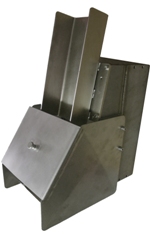
The CentriFlow CFL Type I Meter is perfect for low flow rate applications where product is being conveyed in a horizontal direction. Some applications include the measurement of reclaimed production materials as a way to monitor their addition back into production, micro ingredient additions to mixtures and blends and the monitoring of production at low flow rates to name only a few. The Type I Meter is perfect for measuring relatively free-flowing, larger particle materials such as granules, pellets or even chipped materials and is specifically designed to be installed directly after feed devices such as belts or vibratory conveyors.
The CentriFlow Type II Meter is a bulk solids flow meter designed to measure both free-flowing as well as powdery materials that require enclosed systems. The Type II Meter features an enclosure that houses the meter and is designed to be installed directly after slide gates, rotary airlocks or screw conveyors. Some applications include the measurement of reclaim material during production in order to monitor how efficient other machinery is performing, the measurement of micro-ingredients as additions to mixtures and blends and the monitoring of production at low flow rates to name only a few.
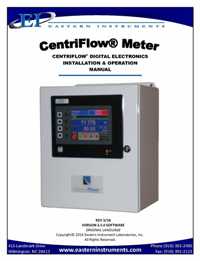
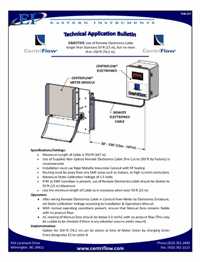
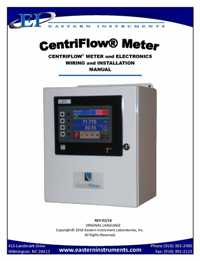
The CentriFlow CFM Digital Electronics is a remote electronics package that comes standard with every CFM model CentriFlow Meter. The meter is connected to the electronics via the included electronics cable. The standard electronics cable that comes with each meter measures 25 feet in length, but the length of the cable can be customized for longer cable runs. Below are some of the remote electronics package's features and benefits:
FEATURES AND BENEFITS
The CentriFlow CFM Meter electronics package features a color touch screen HMI that makes calibration as easy as pushing a button.
Both the flow rate and the total are displayed simultaneously on the main screen.
The CentriFlow CFE Electronics have a universal power supply that requires incoming power of between 85 and 264 VAC.
The CFM Electronics' HMI display supports an on-screen plot/trend of the flow through the meter.
The CFE Electronics comes with settings for alarms on both the flow rate and the total.
The standard outputs for the CFE CentriFlow Electronics include a 4-20 mA signal that is equivalent to flow rate, and a Pulse Output that is equivalent to total.
If connecting to a PLC or other controller, the CentriFlow CFE Electronics will communicate using the Ethernet/IP protocol. Flow rate, total and a variety of other data is transmitted to the PLC and commands from the PLC to change calibration values among other things, can be sent down from the PLC to the meter.
Eastern Instruments has extensive capabilities to customize the programming for the CFE electronics, which includes both the interface as well as the underlying functionality. Multiple units can even be connected to communicate for applications involving mixing or blending. Contact us today!