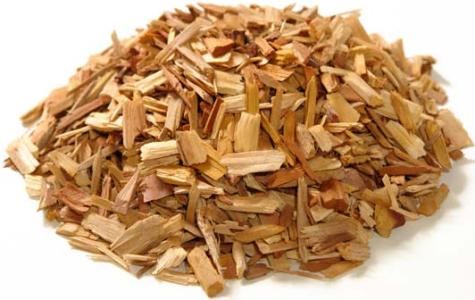
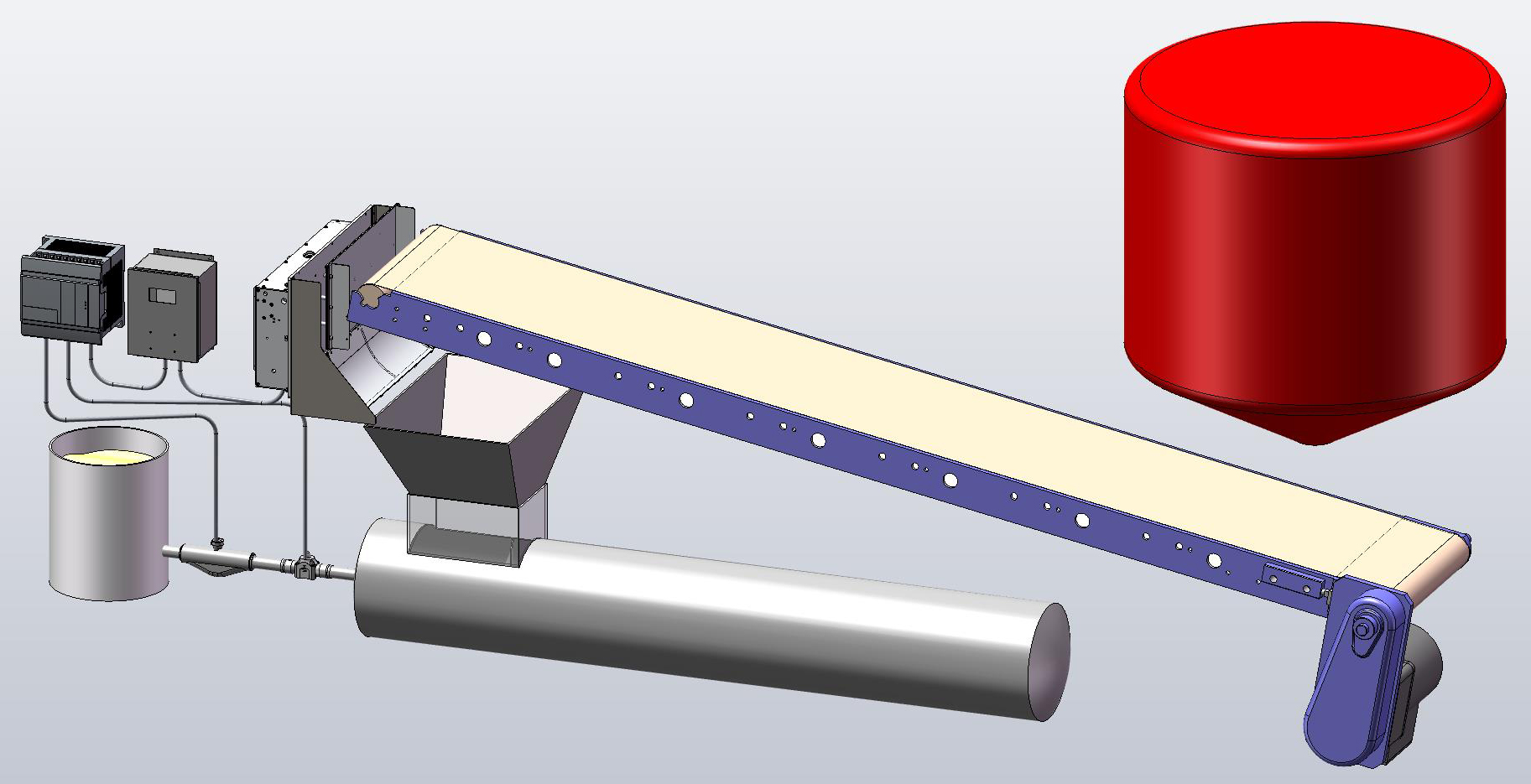
A customer needed to accurately measure the mass flow rate of wood flakes as they were fed into a resin mixer system. The process was to skim coat wood flakes during the manufacturing of OSB (oriented strand board) for a more uniform and protective surface on the finished product. In the past, the customer used a volumetric screw feeder to meter wood flakes, and this did not provide the accuracy required to maintain a consistent, quality, finished product. With resin being the more costly material, the process needed to remain within specification. The wood flakes were to offload from a silo, onto a conveyor, through a mass flow meter, then proceed onto the screw mixer. Due to existing space constraints, the mass flow meter needed to be compact. They also needed the meter to be able to give an instantaneous output in order to accurately control the amount of resin being added to the process. The ratio of wood flakes to resin is critical for strength. The average density of the wood flakes is 9 lb/ft3 with a maximum volumetric flow rate of 6 T/hr and a minimum of 3.6 T/hr. This meant that the flow meter needed to be capable of handling and accurately measuring from 13.3 to 22.2 ft3/min. The flow meter needed to have a local display indicating flow rate and total weight of product from the conveyor before entering the mixer.
THE SOLUTION FROM EASTERN INSTRUMENTS
The customer installed a CentriFlow Meter. The unit selected for installation between the belt conveyor and the screw mixer, was a 24" Type I CentriFlow Meter. The integrated Ratemeter/Totalizer was used to locally display flow rate and to totalize the flow from each load. A second totalizer was used to totalize the weekly weight received from the silo. The Ratemeter/Totalizer also provided an averaged 4-20mA output signal, proportional to the flow rate, that was directed to the customer's PLC. The PLC was connected to a valve on the resin tank that could control the flow of resin entering the screw mixer. In this way, the PLC could use the flow rate generated by the meter to adjust the flow of the resin.
CONCLUSIONS
Once the CentriFlow Meter was installed and the unit was calibrated, the unit performed reliably and well within the stated accuracy. The customer is now able to accurately control the ratios of materials being mixed, allowing for the manufacture of a more consistent and cost-effective product.
MATERIAL TEST REPORTS
The CentriFlow has measured a variety of ingredients for manufacturing drywall including gypsum, calcium carbonate and powdered lime. For plywood, the CentriFlow is often used in order to properly ratio the wood chips and shreds with the adhesive used to manufacture the plywood.