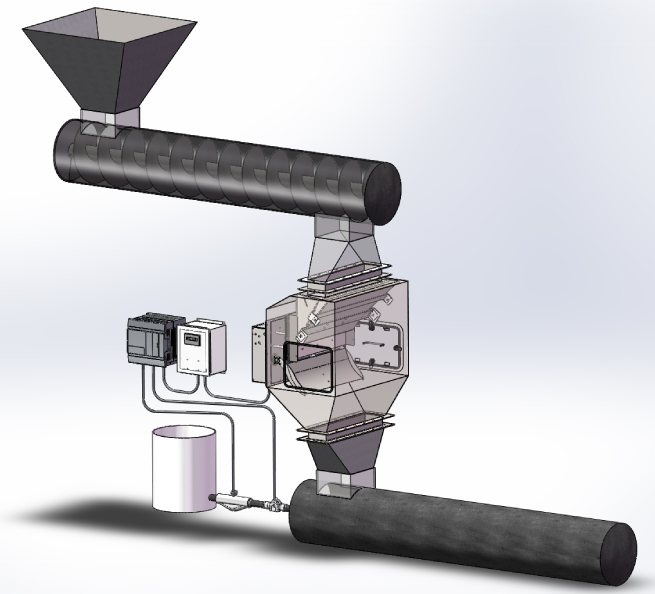
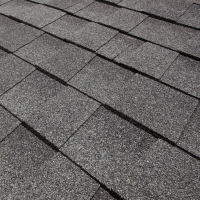
A manufacturer of roofing shingles needed to accurately measure the mass flow rate of calcium carbonate filler (powder) for their process mix of calcium carbonate and hot liquid asphalt. This mixture makes up the roofing shingle substrate. Too much calcium carbonate in the mixture ratio will cause the shingles to become brittle, beyond specification. Calcium carbonate is the less expensive material in the process with liquid asphalt being the more expensive material. The goal was to more accurately ratio the asphalt to the calcium carbonate to optimize material usage and to produce a better product. In the past, an accurate powder measurement was not possible and therefore, more asphalt was added to yield a non-brittle product. The calcium carbonate was to be moved by a screw conveyor, flow through a mass flow measurement system, and then into a mixing screw. At 300oF, an unusually high product temperature, the density of the calcium carbonate filler was 45-65 lb/ft3 with a maximum flow rate of 80K lb/hr and a minimum flow rate of 68K lb/hr. This meant that the mass flow measurement system needed to be capable of handling and accurately measuring a volumetric capacity from 1511-1778 ft3/hr, and capable of keeping the heated calcium carbonate from clumping and clogging the meter.
THE SOLUTION FROM EASTERN INSTRUMENTS
The customer installed a CentriFlow Meter. The unit selected for installation, was a CentriFlow 24" Type II Meter, being fed vertically from a screw conveyor. The meter was equipped with both the high-temperature option and VibraWeigh to accommodate the product's unusually high temperatures and tendency to clump. An integrated Rate meter/Totalizer was used to locally display the flow rate and total flow of product moving through the meter. The Ratemeter/Totalizer also averaged the 4-20mA output (proportional to flow rate) to the customer's PLC, which in turn, controlled the valve controlling the flow of hot asphalt to the screw mixer. Using the flow rate of calcium carbonate, the PLC could deter-mine the appropriate flow rate for the hot asphalt into the mixing screw.
CONCLUSIONS
Once the CentriFlow Meter was installed and the calibration was completed, the meter performed well within the desired accuracy of +/-0.25% of the full-scale volumetric flow rate. The accuracy of the CentriFlow Meter allowed for the calcium carbonate filler and liquid asphalt ratio to be controlled within a tight tolerance. This tight control over the operation allowed for major savings in materials as well as a more consistently manufactured product.
MATERIAL TEST REPORTS
A variety of CentriFlow Meters have been used in the production of shingles, in order to measure the various components of the shingles as the shingles are being manufactured. They have even been installed in locations measuring the load-out as these components are loaded into trucks and railcars.