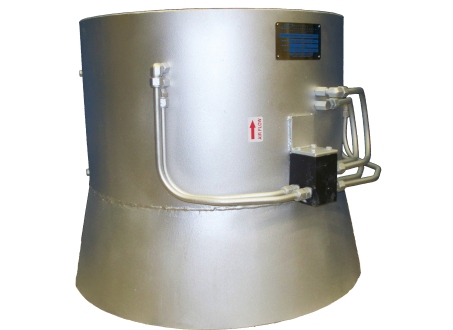
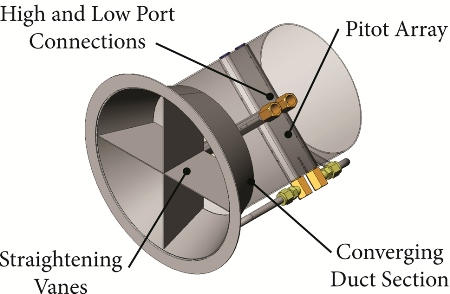
The High Beta Engineered flow conditioner is a proprietary-designed flow-conditioning device that is designed to minimize pressure loss while straightening flow in combustion air flow ducts with relatively few or almost no straight duct runs upstream and/or downstream. Eliminating cyclonic, turbulent, and reverse flow at the point of measurement, the High Beta optimizes flow conditions so that the accompanying VAP Pitots can obtain their maximum accuracy.
The High Beta consists of a flanged 304 stainless steel duct section that can be inserted into either round or rectangular ducts. A converging section effectively straightens the flow profile and accelerates air through its round measurement area. An array of VAP pitots is housed within each HBE that will provide an accurate differential pressure output for the highest degree of air flow measurement and control of your process. The High Beta is erosion resistant and can handle typical process temperatures up to 700oF. Additionally, the High Beta can be *NIST reference calibrated prior to installation. Typical *NIST calibrated total flow uncertainties can be as low as +/-0.50% over the calibrated range.
The trend to improve efficiency in today's power plant environment drives the need for effective boiler trim controls which, in turn, requires accurate combustion air flow measurement. Air flow measurement that is not repeatable, accurate, or representative of mass flow can destabilize the airflow control loop. Air flow is at its most accurate when the flow being measured has no turbulent, reverse, or cyclonic flow patterns and is evenly profiled across the duct at the measurement point. Typically, a flow conditioner, such as the High Beta from Eastern Instruments, is required to alleviate these types of flow disturbances.
The High Beta Engineered (HBE) flow conditioner is ideal for profiling even the most turbulent flows and is perfect for applications where ducts are not uniform or are irregular in size and shape, such as those seen in the duct work of power plants measuring Primary Air, Secondary Air, Over-fired Air or Tempering Air among other applications.
The combustion process can be understood as a mass-based relationship in which optimization occurs through the stoichiometric balance between the mass of air and the mass of fuel or feed stock being combusted. Whether the fuel is coal or a biomass feed stock such as wood chips, construction debris, or even soybeans or sugar cane, the proper fuel-to-air ratio is critical to increasing the efficiency of the burners and maintaining an optimal temperature for the boilers.
SUPERIOR PLUG RESISTANCE FOR "DIRTY" AIR
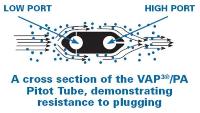
In many cases, pitot tubes have one port facing into the air stream (high), and one port at 90o to the air stream (low). The differential pressure between the HIGH and LOW ports represents the velocity. Situated in this way, however, the "high" port is vulnerable to plugging from airborne particulate including fly ash or debris caused during the combustion process.
The HBE is equipped with VAP pitots which place the HIGH port in-line with airflow, which means it has no impact ports and is thus resistant to the plugging issues associated with standard pitots.